


Processing Equipment and Process Solutions for Skarn-Type Gold Deposits | Customized High-Efficiency Gold Extraction and Mineral Processing Production Lines
Skimar-type gold deposits are one of the major types of gold deposits in China. They are often associated with multiple metals such as copper, iron, lead, and zinc. The ore characteristics are complex, and the gold is tightly disseminated, ranging from gold enclosed in sulfides with good flotation properties to fine-grained gold occurring in gangue or oxidation zones.If the wrong process is chosen, the recovery rate may be as low as 50–60 percent; with the right process, the recovery rate can be consistently maintained at over 90 percent. This difference is precisely where the value of skarn-type gold ore processing equipment and process solutions lies.Starting with the characteristics of the ore, this article systematically explains the mineral processing flow sheets for skarn-type gold deposits, core equipment configurations, common pitfalls, and how to customize a highly efficient gold extraction production line that is truly suited to your mine.
I. What Are Skarn-Type Gold Deposits? Why Are They “Difficult to Process”?
Skarn-type gold deposits are formed through contact metamorphism between magmatic hydrothermal fluids and carbonate host rocks. Typical mineral assemblages include garnet, pyroxene, fuchsite,calcite, quartz, and other skarn minerals, as well as metal sulfides such as pyrite, chalcopyrite, magnetite, arsenopyrite, galena, and sphalerite. Gold is commonly found in the form of free gold, gold enclosed in sulfides, and tellurides.
The “difficulty” of these deposits is primarily reflected in four aspects:
1. Complex mineralization patterns: Multiple forms of gold coexist within the
same ore body, potentially including coarse-grained free gold (recoverable by gravity separation), sulfide-encased gold (recoverable by flotation), fine-grained disseminated gold (requiring fine grinding or leaching), and fine-grained gold enclosed in gangue(which is difficult to process). A single processing method often fails to address all these aspects effectively.
2. Complex polymetallic associations make separation difficult
. Skarn-type gold deposits are often associated with copper, iron, lead-zinc, and sulfur. During flotation, the minerals interfere with one another, resulting in high cross-contamination in the concentrates and severe price reductions and deductions by smelters.The reagent regimes for separating copper from gold, lead from zinc, and sulfur from gold are highly dependent on ore sample testing.
3. High sulfide content affects leaching and environmental
protection. When pyrite, magnetite, and arsenopyrite content is high, cyanide leaching consumes large amounts of reagents and may even lead to “gold robbery”; the oxidation of sulfides in tailings may also pose a risk of acidic wastewater.
4. Significant Variability in Ore Properties:
Skarn deposits exhibit distinct zoning, with substantial differences in ore properties between near-contact and far-contact zones, as well as between oxidized and primary zones. The processing plant\'s workflow must therefore possess a certain degree of adaptability and flexibility.
For this very reason, skarn-type gold mines cannot simply follow blueprints or apply a single process; they must adhere to the principle of “test first, design later,” letting ore sample data guide the process. This is the prerequisite for designing a customized, highly efficient gold extraction and beneficiation production line.
II. Mainstream Process Routes for Skarn-Type Gold Deposits
Depending on the form of gold in the ore, the sulfide content, and the types of associated metals, skarn-type gold deposits typically employ the following process routes or combinations thereof:
Route 1: Single-stage flotation (suitable for ores where gold is primarily encapsulated in sulfides)
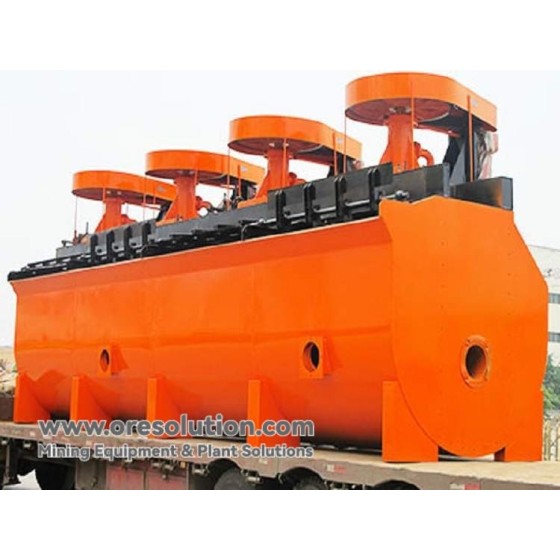
. After grinding, flotation concentrates the gold into sulfide concentrates such as pyrite and chalcopyrite, which are then sent for smelting or further leaching. This process is simple and requires a lower investment, making it suitable for ores where gold is primarily present in sulfides.Key equipment: jaw crushers, cone crushers, ball mills, hydrocyclones, SF/BF-type flotation cells, high-efficiency thickeners, and filter presses.
Route 2: Combined gravity separation and flotation (suitable for ores containing coarse-grained free gold)
. The front end uses jigs, shaking tables, and centrifugal separators to achieve “early liberation and early recovery,” first extracting the coarse-grained free gold to prevent loss due to over-grinding; the tailings are then subjected to flotation to recover gold encapsulated in sulfides.This is a highly effective and classic combination for skarn-type gold deposits, capable of significantly improving the overall recovery rate.
Route 3: Combined Flotation and Leaching (Suitable for complex associations and concentrate reprocessing)
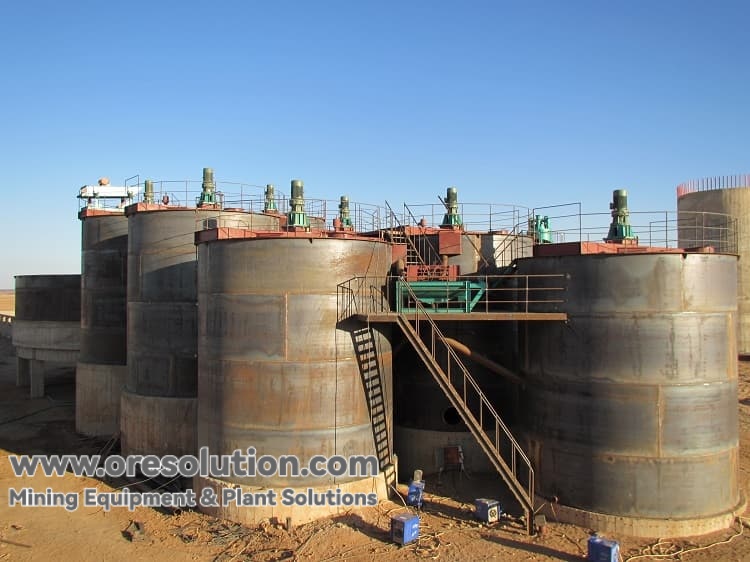
First, flotation is used to produce gold concentrate; the concentrate is then regrinded and subjected to cyanide leaching (CIL/CIP), or the flotation tailings are leached. This is suitable for ores with complex gold occurrence patterns where single-stage flotation recovery rates are unsatisfactory.Key equipment additions include a regrinding mill, a high-efficiency dual-impeller carbon-in-leach tank, a carbon-separating screen, desorption electrolysis equipment, a gold smelting furnace, and a tailings concentration and filter press system.
Route 4: Pretreatment + Leaching (Suitable for difficult-to-process ores with high arsenic, carbon, and sulfur content)
For ores containing gold encapsulated in arsenopyrite or carbon-bearing “gold-trapping” ores, pretreatment such as roasting and oxidation, bio-oxidation, or pressurized oxidation is required to break open the inclusions before leaching.This is a specialized solution for difficult-to-process skarn gold ores; it involves high technical barriers and must be validated through pilot testing.
Route 5: Integrated Multimetal Recovery (suitable for copper-gold and lead-zinc-gold co-occurring ores)
This approach employs a priority flotation or mixed flotation-separation process to first recover valuable metals such as copper and lead, followed by gold recovery, thereby achieving “multiple sales from a single ore.”The combinations of inhibitors and collectors for copper-gold and lead-zinc separation must be precisely tailored through exhaustive testing.
OreSolution\'s Position: Among the above approaches, there is no “best” option—only the “most suitable” one. Our team of experts will flexibly combine gravity, magnetic, flotation, and leaching processes based on your ore sample test reports to tailor a process specifically for your needs, rather than providing you with a one-size-fits-all solution.
III. Core Equipment Configuration: What Does a High-Efficiency Gold Extraction and Beneficiation Production Line Consist Of?
Taking the typical skarn gold ore combined process of “crushing—grinding—gravity separation—flotation—dewatering” as an example, the core equipment configuration is as follows:
1. Crushing and Screening Section
: Jaw crusher (primary crushing), cone crusher (secondary and tertiary crushing), vibrating screen, feeder, and belt conveyor. The goal of the crushing section is to reduce the ore to the feed size required for grinding while adhering to the principle of “crush more, grind less” to minimize energy consumption during grinding.
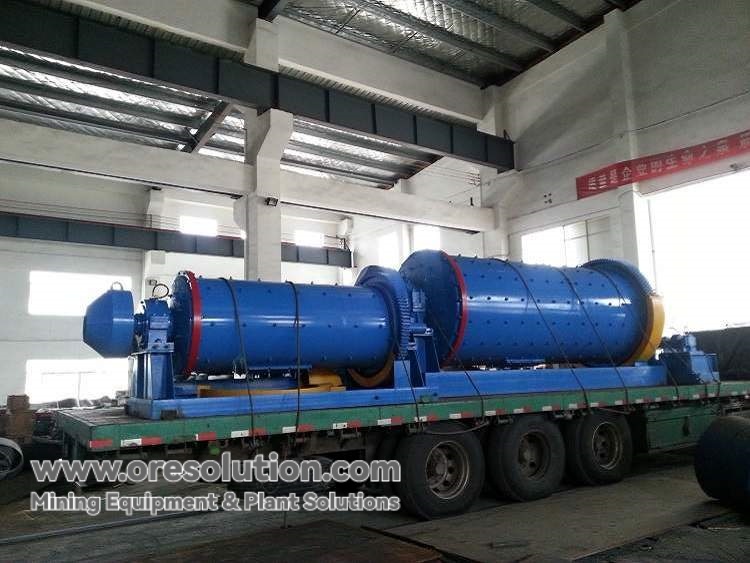
2. Grinding and Classification Section: Ball
mills (grid or overflow type), spiral classifiers, and hydrocyclones.The fineness of grinding directly determines the degree of individual liberation. For skarn gold deposits, the grinding fineness must be determined based on the grain size distribution to avoid under-grinding (insufficient liberation) or over-grinding (loss due to sludging).
3. Gravity separation section (for recovering coarse-grained free gold)
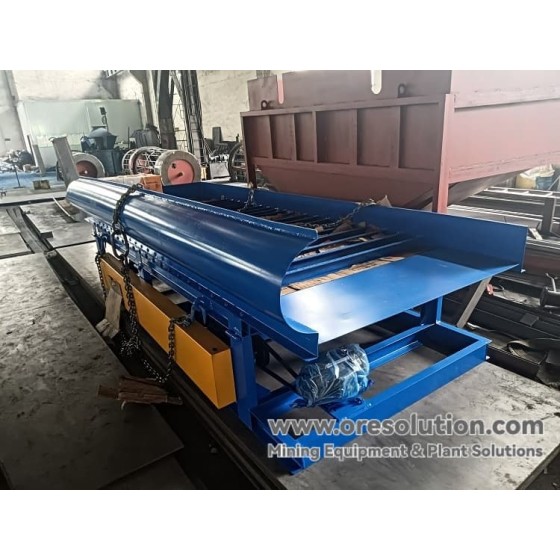
: sawtooth jigs, 6-S shaking tables, centrifugal separators, and spiral chutes.Following the principle of “early liberation, early recovery,” jigs or centrifuges are incorporated into the grinding circuit to recover coarse-grained gold as early as possible, thereby preventing its loss in the flotation system.
4. Flotation Section (Recovery of Gold Enclosed in Sulfides and Associated Metals)
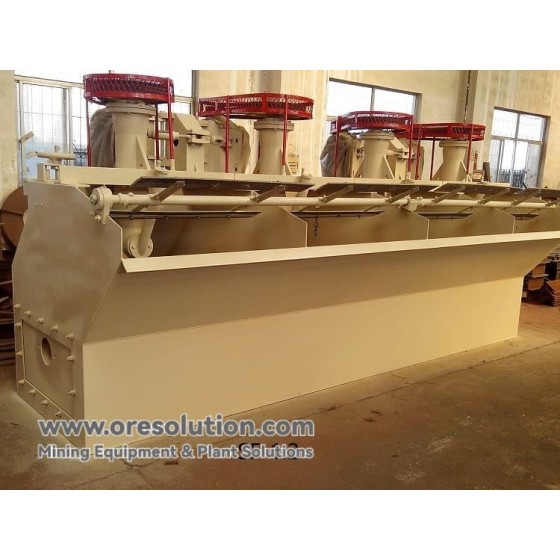
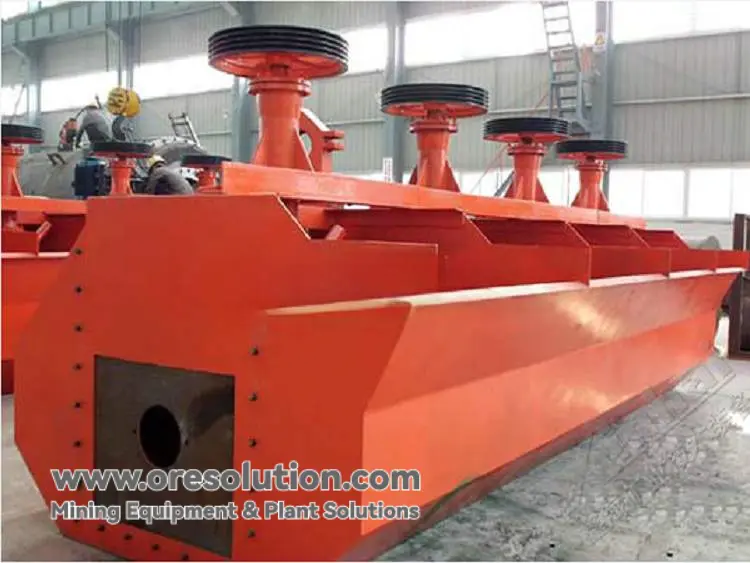
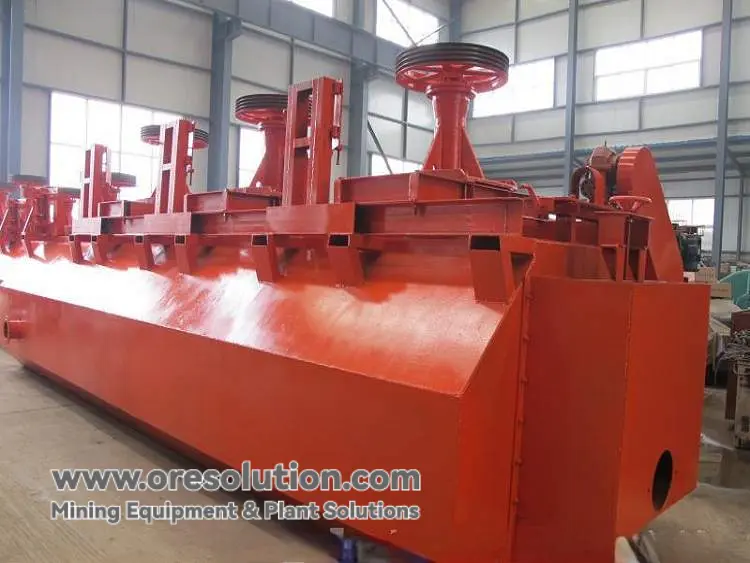
: SF-type, BF-type, and XCF/KYF-type flotation cells, in conjunction with agitation tanks and dosing systems.The number of roughing, scavenging, and cleaning stages is determined based on test results; copper-gold and lead-zinc separation require the use of regrinding mills and specialized reagent regimes.
5. Dewatering Section
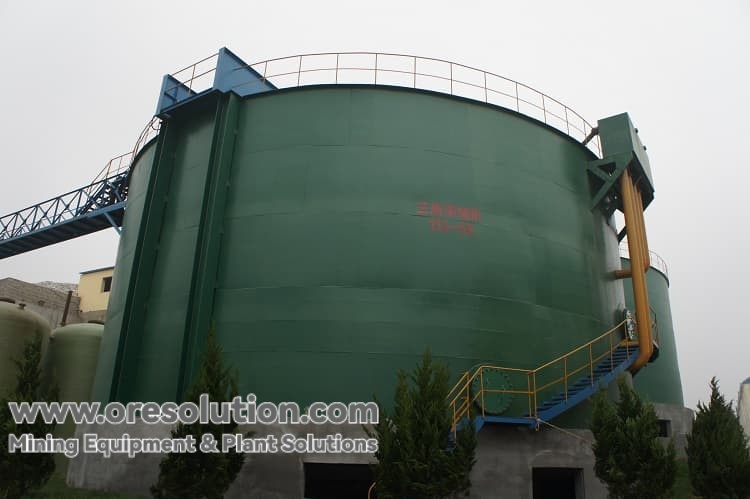
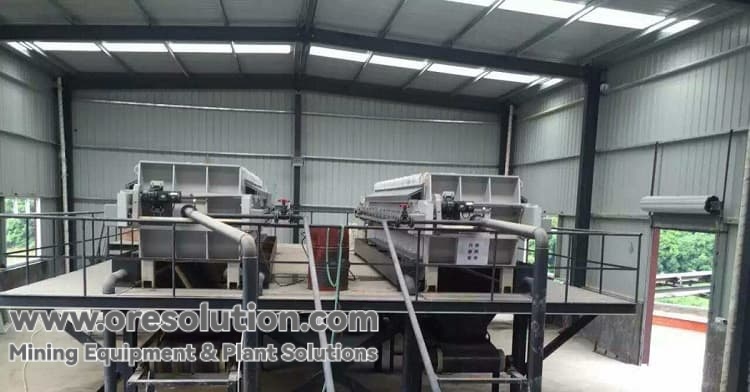
: High-efficiency thickeners, filter presses, and dewatering screens. Dewatering the concentrate facilitates transportation, while dry tailings discharge benefits environmental protection and tailings dam safety.
6. Leaching and Recovery Section (if a combined process is used)
: regrinding mill, high-efficiency twin-impeller carbon-in-leach (CIL) tank, carbon-separating screen, desorption and electrolysis equipment, gold smelter, high-efficiency tailings thickener, and filter press.OreSolution\'s desorption and electrolysis equipment achieves a desorption rate of over 96% and an electrolysis rate exceeding 99%.
7. Auxiliary and Automation
: Slurry pumps, water pumps, agitation tanks, electrical controls, and online monitoring systems. The level of automation directly impacts production stability and labor costs.
It should be emphasized that the above represents only a typical configuration framework; actual equipment models, quantities, and specifications must be customized based on ore characteristics, processing capacity, and site conditions. Configurations may vary significantly between different mining areas of the same ore type—this is precisely the essence of “customization.”
IV. Five Common Misconceptions in the Beneficiation of Skarn-Type Gold Deposits
Misconception 1: Skipping Pilot Tests and Blindly Copying Blueprints from Similar Mines
Skarn deposits exhibit strong zonation; a process that succeeded at a neighboring mine may prove completely ineffective when applied to your mine. Even slight differences in ore grain size, sulfide types, or oxidation levels can result in drastically different recovery rates.Correct Approach: First, collect representative ore samples to conduct beneficiation tests to determine the gold\'s occurrence and recoverability before finalizing the process flow.
Misconception 2: Relying Solely on Single-Stage Flotation and Neglecting Coarse-Grain Gold Recovery
Many processing plants perform full-scale flotation directly, resulting in the loss of coarse-grain free gold during the grinding and flotation circuits.Correct Approach: Use gravity separation (jigging, centrifuges) to recover coarse-grained gold early in the grinding circuit, followed by flotation to recover fine-grained and entrapped gold; this significantly improves the overall recovery rate.
Misconception 3: Finer Grinding Is Always Better
. Over-grinding leads to the formation of gold slime and gangue slime, resulting in poorer flotation selectivity, increased reagent consumption, and lower concentrate grade.Correct Approach: Based on the optimal single-particle liberation degree determined through testing, grind coarsely where necessary and finely where appropriate; implement staged grinding and staged separation when necessary.
Misconception 4: Piecing Together Equipment, Leading to System Incompatibility
Crushers, flotation cells, and thickeners are purchased from different manufacturers. While individual unit parameters meet standards, when combined, they result in mismatched production capacities, pipeline conflicts, and exceptionally high energy consumption. Correct Approach: Select an EPC supplier with in-house manufacturing capabilities for core equipment to ensure a high degree of integration between the process and the hardware.
Misconception 5: Focusing Only on Equipment Quotes Without Calculating Full Lifecycle Costs
. While inexpensive equipment may have a low initial investment, it often comes with high failure rates, high energy consumption, and significant chemical waste; over the course of several years, the OPEX far exceeds the difference in equipment prices. Correct Approach: Calculate the total cost and evaluate the return on investment over the full lifecycle.
V. Why Choose the EPC Turnkey Model for Customized Production Lines?
The construction of a skarn-type gold ore processing plant involves multiple stages, including testing, design, equipment procurement, construction, and commissioning. Under the traditional model, design institutes draw up plans, equipment manufacturers sell machinery, and construction teams build the plant. If performance targets are not met, multiple parties shift blame onto one another, forcing the mine owner to act as the “referee,” resulting in project delays and cost overruns.
The advantages of the EPC turnkey model lie in:
-
Closed-Loop Accountability: A single team is responsible for the final outcome, coordinating the entire process from testing to production—ensuring a seamless chain of responsibility.
-
Customized Integration: Processes are tailored based on test data from ore samples, and in-house equipment manufacturing capabilities ensure a perfect fit between hardware and process.
-
Cost Reduction and Efficiency Improvement: Eliminates the hidden costs of coordinating multiple parties, shortens the plant construction cycle, and ensures precise equipment selection to avoid over-specification.
-
Savings on Design Fees: Core design phases—including pilot testing, process design, equipment selection, plant layout, civil engineering drawings, and technical briefings—are handled in-house by the EPC team, saving hundreds of thousands of dollars in design fees for medium- to large-scale projects.
VI. OreSolution\'s EPC Turnkey Services for Skarn-Type Gold Mines
OreSolution specializes in mining equipment and mineral processing solutions, with operations spanning five major sectors: metal ores, non-metal ores,precious metal mines, alluvial mines, and tailings and solid waste. The company operates three modern manufacturing bases (Shahe Industrial Park in Zhanggong District, Ganzhou, Jiangxi; Guzhang Industrial Park in Shicheng County, Ganzhou, Jiangxi; and Weifang Heavy Industry Park in Shandong),with 20 years of experience in mining equipment manufacturing and solution integration. Our products are exported to more than 80 countries and regions worldwide.
For skarn-type gold mines, we provide comprehensive EPC turnkey services:
Step 1: Requirements Discussion and Preliminary Assessment
—We assess the ore type, grade, associated metals, processing capacity, site conditions, and target recovery rate to provide a preliminary feasibility assessment and recommend a processing approach.
Step 2: Ore Sample Analysis and Mineral Processing Tests Conduct chemical composition analysis, phase analysis, embedded grain size determination, and mineral processing tests (comparative testing of gravity separation, flotation, leaching, or combined processes)
on representative ore samples. Issue an authoritative “Mineral Processing Test Report” recommending process flows, process parameters, equipment selection, and expected performance indicators.This forms the scientific foundation of the entire project.
Step 3: Customized Solution Design and Quotation
Based on the test report, we complete the Process Flow Diagram (PFD), equipment configuration list, plant layout plan, 3D layout proposal, and civil engineering requirements drawings, and provide a transparent EPC (Engineering, Procurement, and Construction) budget.
Step 4: Equipment Manufacturing and Quality Inspection
Core equipment (crushers, ball mills, flotation cells, jigs, shaking tables, centrifuges, thickeners, filter presses, carbon-in-leach tanks, desorption and electrolysis equipment, etc.) is manufactured strictly in accordance with drawings and standards, and undergoes rigorous quality inspection prior to shipment to ensure performance meets specifications.
Step 5: On-Site Installation Guidance and Commissioning
We dispatch senior engineers to the site to guide equipment positioning, piping connections, and electrical installations; complete individual unit commissioning and full-process integrated test runs; and conduct commissioning with water and feed material until the production line operates stably and meets the contractually agreed-upon performance metrics.Civil engineering work is organized and carried out by the client according to the drawings; we provide technical briefings. Installation workers are sourced locally by the client, with our engineers providing on-site guidance—resulting in lower labor costs and greater flexibility.
Step 6: Personnel Training and After-Sales Support We provide systematic theoretical and hands-on training
for operators and maintenance teams (including equipment start-up and shutdown, parameter adjustment, daily inspections, and troubleshooting). We offer a 12-month warranty period; during this period, spare parts are replaced free of charge for quality-related issues. After the warranty period, we provide lifetime technical support at cost only.
Estimated Timeline: From ore sample testing to final commissioning, the overall timeline is typically 8–12 months (ore processing testing: 30–45 days; engineering design: approximately 30 days; equipment manufacturing: approximately 60 days; logistics and transportation: approximately 60 days; installation and commissioning: 60–150 days), though this may vary depending on the project\'s scale and complexity.
VII. Frequently Asked Questions (FAQ)
Q: Is it necessary to conduct mineral processing tests for skarn-type gold deposits?
A: Absolutely. Skarn-type gold deposits feature complex ore distribution patterns, polymetallic associations, and highly variable ore properties; designing a process without testing is like “a blind man feeling an elephant.” The test report serves as the sole scientific basis for process design, equipment selection, and performance commitments.
Q: My ore contains arsenic and carbon, and the flotation recovery rate is very low. Is there still a solution?
A: Yes. Difficult-to-process gold ores containing arsenic and carbon require pretreatment processes (roasting and oxidation, bio-oxidation, or pressurized oxidation) to break open inclusions or eliminate the “gold-stealing” effect, followed by flotation or leaching. The specific solution must be determined through testing, which is precisely where our specialized expertise lies.
Q: What recovery rate can you guarantee?
A: The recovery rate depends on the characteristics of the ore itself (grade, grain size of gold particles, association with other minerals, degree of oxidation, etc.).We do not promise figures plucked out of thin air; what we do promise is this: through rigorous mineral processing tests, we will design a process that achieves the highest possible recovery rate under the conditions of the specific ore, and we will strive for excellence in equipment selection and process control to ensure that actual production metrics closely match the test expectations.
Q: Can you retrofit existing plants and upgrade production capacity?
A: Yes. We diagnose existing processing plant operations, take tailings samples for analysis, identify bottlenecks, optimize processes, and replace inefficient equipment—all to achieve simultaneous increases in production capacity and recovery rates with minimal investment.
Q: My mine is overseas. Can you provide on-site support?
A: Yes. We export equipment to over 80 countries and offer technical coordination in English or bilingual formats. Our expert engineers can travel to the site to supervise installation, conduct commissioning with actual feed, and provide staff training. We are familiar with logistics routes across Africa, Southeast Asia, South America, Central Asia, and the Middle East.
Q: Are there fees for testing and design?
A: We charge a basic service fee, which is reasonable. Upon signing an equipment or EPC contract, the initial testing and design fees can be fully offset against the equipment cost. Testing services can also be purchased separately; there is no obligation to enter into subsequent cooperation.
VIII. Customizing a Production Line That Truly Suits Your Mine
There is no “one-size-fits-all” process for skarn-type gold deposits—only “tailored solutions.” Even among skarn gold deposits, the process routes can vary drastically depending on whether they contain copper or not, whether they consist primarily of coarse-grained gold or fine-grained inclusions, and whether they are in the oxidized zone or the primary zone.The “efficiency” of a high-efficiency gold recovery and beneficiation production line does not lie in how expensive the equipment is or how complex the process is, but rather in how precisely it matches the properties of your ore.
OreSolution positions itself as your full-cycle mining partner: testing first, then design; a single team takes full responsibility for the final results, providing end-to-end EPC turnkey delivery—from ore sample testing, process design, equipment manufacturing, installation, and commissioning to personnel training.Conventional processes ensure minimum performance, while proprietary technologies maximize potential—whether your skarn gold deposit is conventionally easy to process or complex and difficult to treat, we have a specialized solution tailored to your needs.