


Project Case Study: Delivering a 1,000 TPD Gold CIL Processing Plant in South America
South America's Andes mountains harbor some of the richest, yet most metallurgically complex, gold deposits on Earth. Mining companies operating in these high-altitude regions face a relentless barrage of challenges: refractory ores, extreme logistical bottlenecks, and some of the world's most stringent environmental and cyanide-handling regulations.
In 2022, an established mining group acquired a historic, underperforming asset in the region. The previous operator had abandoned the site because their traditional gravity and vat-leaching plant was only achieving a dismal 45% gold recovery. The new owners engaged OreSolution with a massive EPC (Engineering, Procurement, and Construction) mandate: Design, manufacture, and commission a modern 1,000 Tons Per Day (TPD) Gold CIL (Carbon-in-Leach) Plant that could break the 90% recovery barrier, despite the ore being heavily contaminated with soluble copper.
This comprehensive case study provides an inside look at how OreSolution engineered a metallurgical turnaround, navigating complex copper-cyanide chemistry and high-altitude construction to deliver a highly profitable, turnkey Gold CIL Production Line.
By engineering a customized pre-leach washing circuit and deploying an advanced Zadra elution system, OreSolution increased the plant's overall gold recovery from 45% to a sustained 92.8%. Processing 1,000 tons per day at an average head grade of 3.2 g/t, this technological upgrade generated an additional 1,500+ ounces of gold per month, paying off the entire EPC capital expenditure within the first 11 months of operation.
 Phase 1: The Metallurgical Diagnostic (Lab Testing)
The foundation of every OreSolution EPC project is empirical data. Before drawing a single blueprint, we transported 2 tons of representative drill core to our Metallurgical Laboratory. The diagnostic revealed exactly why the previous operator had failed.
| Ore Characteristic | Lab Parameter | Engineering Impact & Challenge |
|---|---|---|
| Head Grade | 3.2 g/t Au, 15 g/t Ag | Highly profitable, provided recovery exceeds 85%. |
| Grindability | Bond Work Index (BWI) = 18.5 kWh/t | Extremely Hard Rock. A standard ball mill would choke. Required a heavy-duty, two-stage crushing and grinding circuit. |
| The "Killer" Impurity | Soluble Copper (0.4% Cu) | Cyanide Consumer. The copper was dissolving in the cyanide before the gold could, causing reagent costs to skyrocket and robbing the gold of leaching chemicals. |
| Preg-Robbing Carbon | Moderate active graphitic carbon | Required immediate adsorption. Dictated the choice of CIL (Carbon-in-Leach) over CIP (Carbon-in-Pulp) to outcompete the natural carbon. |
Phase 2: Flowsheet Engineering - Overcoming the Copper Penalty
Armed with the lab data, our engineering team designed a bespoke flowsheet tailored to neutralize the high-copper and hard-rock challenges.
1. The Comminution Strategy (Crushing & Grinding)
Due to the high BWI (hardness), we designed a robust three-stage crushing circuit using a primary Jaw Crusher and two Cone Crushers, bringing the ore down to a uniform -12mm.
The grinding circuit utilized a large primary Ball Mill operating in closed circuit with Hydrocyclones. We targeted a highly specific grind size of P80 = 74 microns (200 mesh) to fully liberate the microscopic gold from the quartz matrix.
2. The Pre-Leach Copper Wash (The Game Changer)
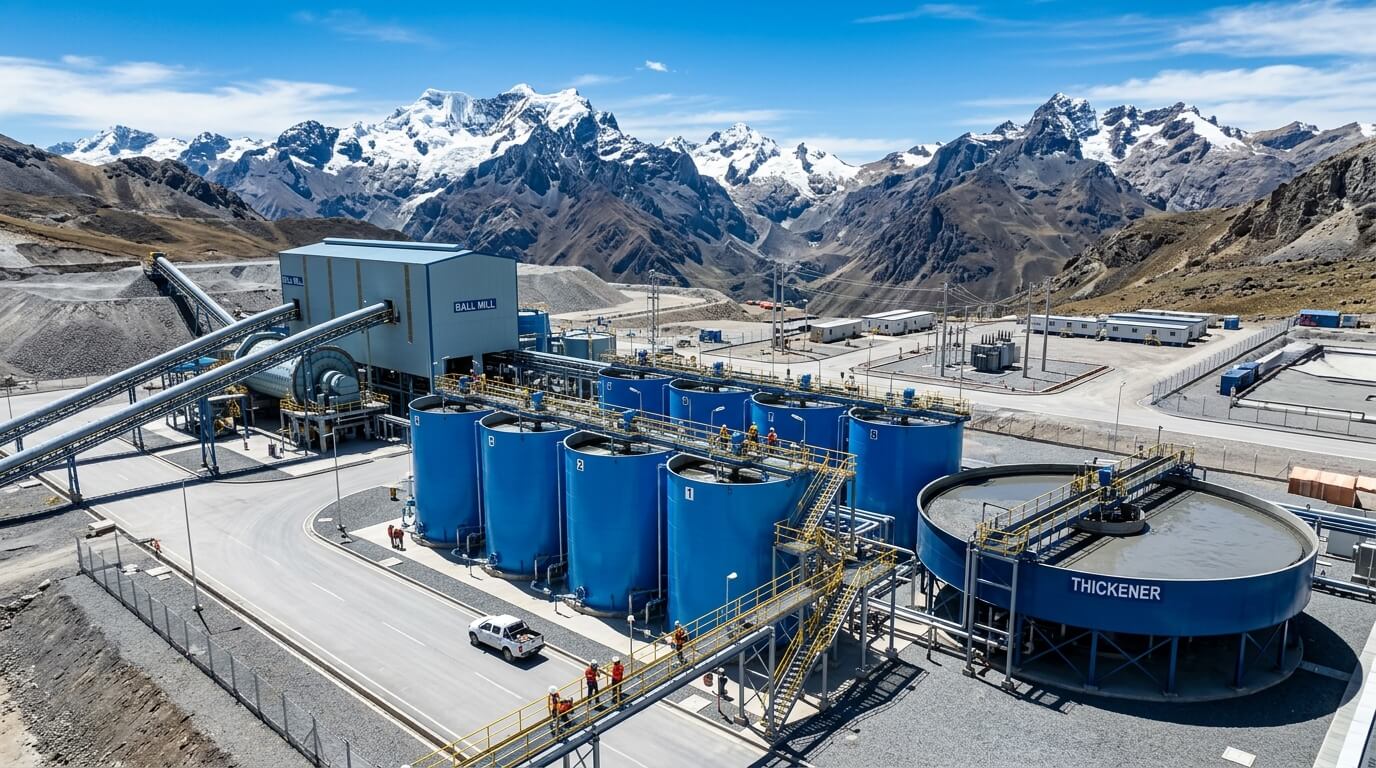
To solve the copper-cyanide consumption issue, OreSolution implemented a mild acid-washing and thickening stage before cyanidation. The slurry was pumped to a High-Efficiency Center Drive Thickener where the soluble copper was washed out into the overflow water (and recovered separately). The thickened, clean underflow (at 45% solids) was then pumped to the CIL tanks, instantly slashing cyanide consumption by 60%.
3. The CIL (Carbon-in-Leach) Tank Cascade
The heart of the plant consisted of eight massive, mechanically agitated leaching tanks. We injected high-purity oxygen (rather than just compressed air) into the first two tanks. This supercharged the leaching kinetics, cutting the required retention time from 36 hours down to 24 hours.
Activated coconut-shell carbon was pumped counter-currently from Tank 8 up to Tank 1, acting like a sponge to instantly absorb the dissolved gold, successfully nullifying the ore's natural "preg-robbing" characteristics.
.png)
Phase 3: Desorption, Electrowinning & Smelting
Once the carbon in Tank 1 was fully loaded with gold (reaching approx. 3,500 g/t Au), it was extracted and sent to the Gold Room.
OreSolution manufactured and installed a high-temperature, high-pressure Zadra Elution System. Operating at 150°C and 0.5 MPa, a hot caustic-cyanide solution stripped the gold off the carbon in just 14 hours. The pregnant solution flowed into an Electrowinning cell, where direct current plated the gold onto steel wool cathodes. The resulting "gold mud" was acid-washed, dried, and smelted in a high-frequency induction furnace to pour 85%+ pure Gold Doré bars directly on-site.
Phase 4: Eco-Mining & Cyanide Detoxification
South American environmental regulations mandate strict zero-harm policies regarding cyanide discharge. The slurry exiting the final CIL tank could not simply be dumped into a tailings dam.
We engineered an automated INCO SO2/Air Detoxification Circuit. By dosing the tailings slurry with Sodium Metabisulfite (SMBS) and copper sulfate, the highly toxic Free Cyanide and WAD (Weak Acid Dissociable) Cyanide were rapidly oxidized into harmless cyanate. The detoxified slurry was then pumped to a Plate and Frame Filter Press, producing dry, stackable filter cakes for safe, dry-stack disposal.
Phase 5: Logistics, Construction, and Commissioning
Executing a 1,000 TPD EPC project at 3,500 meters above sea level requires military-grade logistics.
| Project Phase | Duration | Milestone Achieved |
|---|---|---|
| Manufacturing & Shipping | Months 1-5 | Over 80 shipping containers manufactured at OreSolution's factory and transported up winding mountain roads to the high-altitude site. |
| Civil & Mechanical Erection | Months 6-10 | Massive concrete pours for tank foundations. CIL tanks welded on-site. Ball mill aligned and anchored. |
| Piping, Electrical & PLC | Months 11-12 | Installation of over 5 km of slurry piping. Full SCADA (Supervisory Control and Data Acquisition) system wired for automated central control. |
| Commissioning & First Gold | Month 13 | Water runs, reagent calibration, and the highly anticipated first Doré bar pour. |
FAQ: Learnings for Future Gold EPC Investors
A: The lab identified "preg-robbing" graphitic carbon in the ore. In CIP, leaching happens first, followed by carbon adsorption. In that time gap, the natural carbon would steal the dissolved gold. CIL (Carbon-in-Leach) adds the activated carbon simultaneously with the cyanide. The commercial activated carbon outcompetes the natural carbon, ensuring the gold is safely captured.
A: At 3,500 meters, the air is thin. Cyanidation (the Elsner Equation) strictly requires dissolved oxygen to dissolve gold. Standard air compressors would not provide enough oxygen, causing the leaching process to stall. OreSolution integrated a dedicated PSA (Pressure Swing Adsorption) Oxygen Generator to inject 90%+ pure oxygen directly into the CIL tanks, ensuring aggressive leaching kinetics regardless of altitude.
A: After the gold is stripped in the Zadra system, the "barren" carbon has its microscopic pores clogged with calcium and organic oils. We installed a Carbon Regeneration Kiln. The carbon is acid-washed to remove calcium, then roasted at 700°C to burn off organics, restoring 95% of its original activity before being pumped back into Tank 8. Proper regeneration saves massive OPEX costs.
Conclusion: Turnkey Success in the Harshest Environments
The successful delivery and commissioning of this 1,000 TPD Gold CIL plant highlights the immense value of a true EPC partnership. By identifying the copper and preg-robbing threats early in the laboratory, and engineering targeted mechanical and chemical solutions, OreSolution transformed a failed, abandoned mine into one of the region's top-performing gold assets.
At OreSolution, we take ultimate responsibility for your recovery rates. From the initial crushing circuit to the final cyanide detoxification filter press, our integrated design, manufacturing, and construction teams ensure your project is delivered on time, on budget, and on grade.
Are you developing a greenfield gold project or struggling with low recovery at an existing plant? Contact OreSolution today to discuss your ore mineralogy and discover how our Turnkey EPC services can guarantee your gold output.