


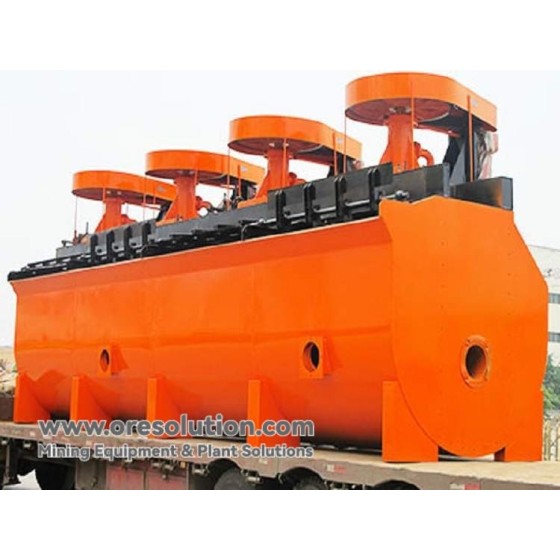
How to Select Fine-Grain Gold? CIP Mineral Processing Solutions and Complete Equipment Sets
Many people assume that fine-grained gold cannot be recovered because the gravity separation equipment is inadequate. In reality, this is often not the case.
When particle sizes are as fine as tens of micrometers or smaller, the recovery limit of gravity separation is fixed; no matter how the equipment is adjusted, it is very difficult to reliably capture fine-grain gold that has already dispersed throughout the slurry. The real bottleneck often lies in the stage where “the gold has been liberated but has not been effectively collected.”
The CIP processing scheme for ultrafine gold addresses precisely this stage. It relies neither on gravity nor on flotation foam; instead, it first uses a cyanide system to dissolve the gold into the liquid phase, and then uses activated carbon to adsorb the gold from the slurry. To understand how ultrafine gold is processed, read on for an explanation from six perspectives.
[30-Second Summary]
- Overview: A gold extraction solution combining “whole-ore cyanide leaching” with “direct adsorption of gold from the slurry using activated carbon”—not a single piece of equipment, but a complete process chain.
- Problems Addressed: Loss of fine-grained disseminated gold during gravity separation, difficulties in filtration and washing due to high clay content, and significant fluctuations in conventional process indicators.
- Technical Core: The leaching and adsorption stages are separated, allowing the leaching and adsorption rates to be optimized independently without interfering with one another.
- Performance Range: Gold leaching rates typically fall within the 88–94% range, while adsorption rates on gold-loaded carbon commonly range from 96–99%, though specific values vary depending on ore properties.
- Limitations: For ores containing carbon-bearing gold, arsenic-sulfide-encased gold, or a high proportion of coarse-grained gold, CIP alone is insufficient; pretreatment or modification of the combined process is required.
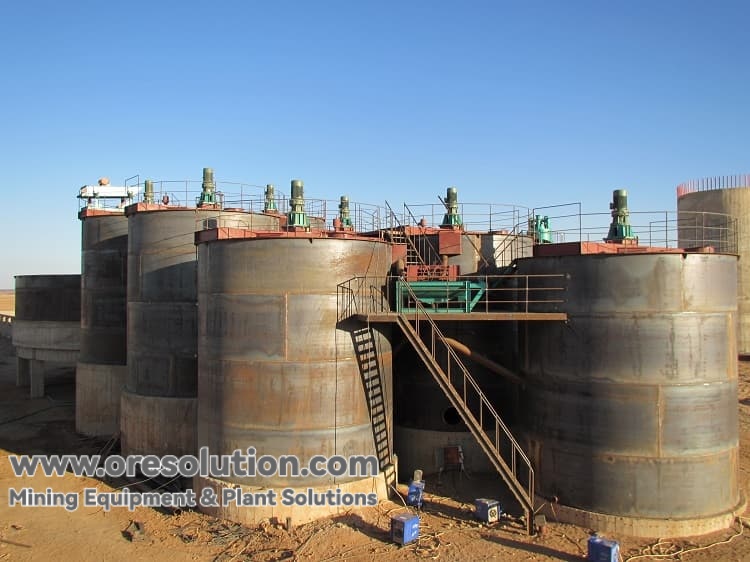
I. Understanding It: What Exactly Is the CIP Mineral Processing Solution?
Key Points: CIP (Carbon-in-Pulp) is a gold extraction process based on whole-ore cyanide leaching, in which activated carbon directly adsorbs gold from the pulp.
To put it more simply, it consists of two steps: leaching the gold out and recovering the gold.The gold dissolution stage involves cyanide leaching, in which an alkaline cyanide solution dissolves gold into complexes; the gold recovery stage involves activated carbon adsorption, as activated carbon exhibits strong selective adsorption capacity for gold-cyanide complexes.
Compared to conventional cyanide processes, the difference lies in a single step. In conventional processes, leaching is followed by filtration and washing to obtain a precious liquid, which is then used for zinc powder displacement;CIP replaces “solid-liquid separation” with “activated carbon adsorption.” This substitution directly makes the process more suitable for ores with high clay content and fine particle sizes.
A complete CIP production line for fine-grained gold—from raw ore feeding to the production of refined gold—constitutes a continuous process chain that also includes several intermediate stages such as concentration, desorption and electrolysis, and tailings treatment. When selecting a process, one can refer to the overall configuration principles of gold CIP production lines.
II. Defining Its Purpose: What Problems Does This Solution Address?
Key Points of the Solution: It is primarily designed for medium- to fine-grained disseminated gold ores where “gold has already been liberated as free particles but cannot be recovered by conventional physical separation methods.”
This solution is particularly effective in the following typical scenarios:
- Gold is present in a fine-grained disseminated state within quartz, silicates, or sulfides, where gravity separation yields limited recovery;
- The ore has a high clay content and contains abundant clay minerals, making filtration difficult after leaching; the filter cake has high moisture content, and washing efficiency is low;
- After conventional cyanidation processes have been operating for some time, tailings gold grades fluctuate significantly, and target grades cannot be achieved;
- Although flotation can concentrate the gold, both concentrate grade and recovery rate are unsatisfactory, requiring a more direct processing route; for such ores, the suitability of gold flotation is typically evaluated concurrently before determining the main process;
- The processing scale is moderate, requiring a continuous process and a streamlined operational staff.
It is most suitable for processing plants with a daily throughput ranging from tens to thousands of metric tons, where the ore is primarily fine-grained and disseminated, and where conditions for cyanidation are available.
If the ore contains a high proportion of coarse-grained free gold, the focus should not be on CIP; it is more cost-effective to recover the coarse-grained gold first. This point will be discussed in detail in Part Five.
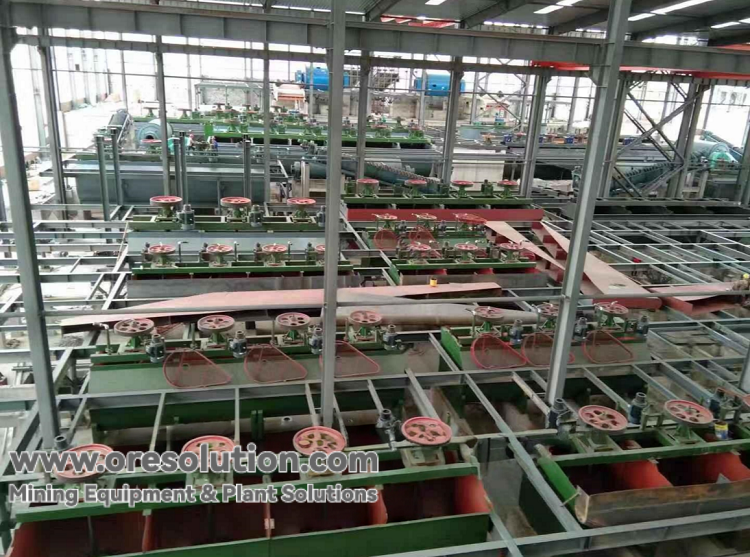
III. Breaking It Down: Core Components and Operating Principles
Key Points of the Solution: This solution can be broken down into six modules, with only two core components—the leaching section and the adsorption section.
[Solution Flowchart]
| Process Step | Main Function | Key Control Points |
|---|---|---|
| Raw Ore Feeding, Crushing, and Screening | Reduce the ore to a feed size acceptable for the mill | Feed particle size uniformity, iron removal |
| Grinding and Classification | To achieve individual liberation of fine-grained gold | Grinding fineness, classification efficiency |
| Concentration prior to leaching | Increase pulp concentration and reduce leaching tank volume | Underrun Concentration, Flocculant Dosage |
| Cyanide leaching (multiple tanks in series) | Dissolving gold into the liquid phase | pH, dissolved oxygen, cyanide concentration gradient |
| Countercurrent adsorption on activated carbon | Adsorption of dissolved gold onto activated carbon | Charcoal density, number of stages, and charcoal screening efficiency |
| Desorption and electrolysis of gold-loaded carbon | Eluting gold from the carbon and depositing it | Desorption temperature, alkalinity, current efficiency |
| Smelting of gold slurry | Production of refined gold | Flux ratio, smelting temperature |
| Cyanide removal from tailings and water recycling | Compliant Discharge and Water Reuse | Cyanide Removal Reagents and Reclaimed Water Quality |
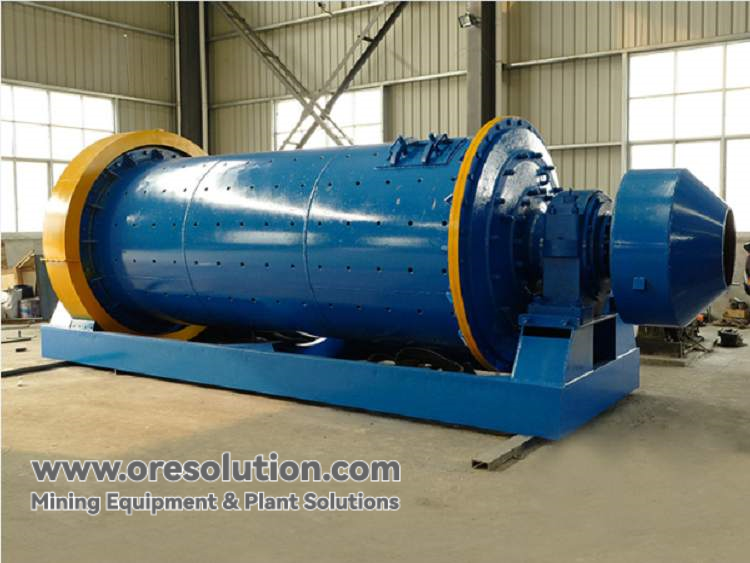
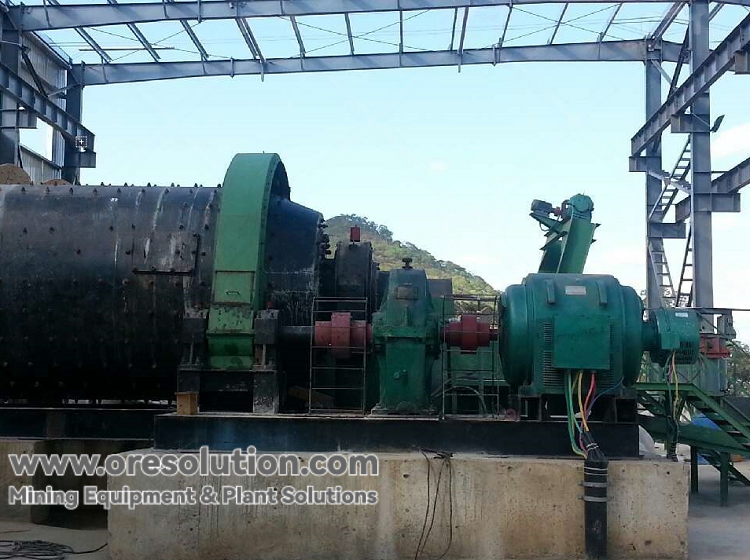
First stage: Crushing and grinding. The liberation of fine-grained gold relies on grinding; if the grinding fineness is insufficient, the leaching rate in subsequent stages is meaningless.The particle size is typically controlled so that 85–95% of the particles are below -0.074 mm; the specific target depends on the gold grain size distribution. Grinding to an excessively fine size will increase power consumption and place a greater burden on subsequent concentration processes. The main grinding equipment usually consists of a ball mill operating in a closed circuit with a classifier to ensure uniform particle size distribution.
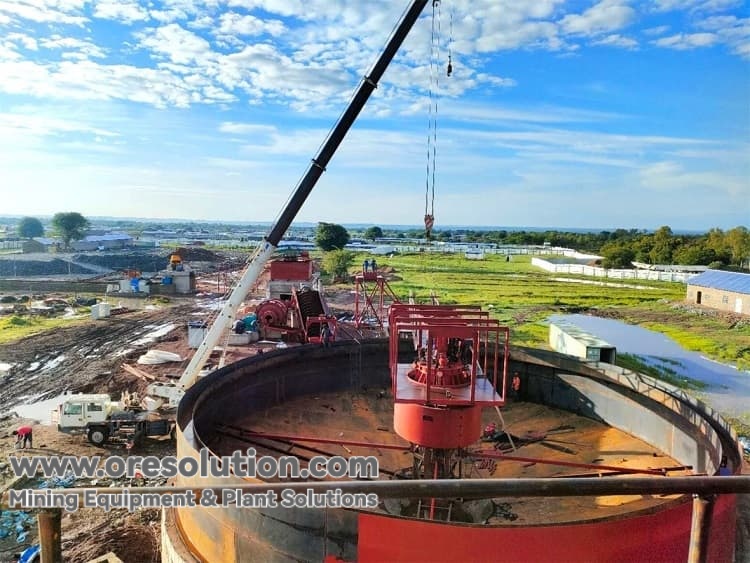
Second, pre-leaching concentration. The slurry concentration directly determines the volume of the leaching tanks and reagent consumption; it is generally controlled within the 35–45% range. High-efficiency thickeners serve to concentrate the slurry and act as buffers here; for ore with high clay content, a flocculant regimen must be specifically considered.
Third, the leaching stage. Multiple leaching tanks are connected in series, with the slurry advancing from tank to tank via gravity or aeration.There are three key control points: maintaining pH within the alkaline range (typically 10–11) to suppress hydrogen cyanide volatilization; ensuring sufficient dissolved oxygen; and gradually reducing cyanide concentration as the slurry progresses through the tanks. The total residence time is typically between 24 and 48 hours.
Fourth, the adsorption stage. This is where the term “CIP” originates. Activated carbon moves countercurrent to the slurry, forming a multistage adsorption process—typically 6–8 stages. The adsorption efficiency is determined by the carbon density, the number of stages, and the screening efficiency; adsorption rates typically range from 96–99%.
Fifth stage: Desorption, electrolysis, and smelting. Gold-loaded carbon is desorbed using hot alkaline solution; the gold enters the rich solution, is then electrolytically deposited as gold slime, and smelted to produce refined gold. The activated carbon is regenerated and returned to the adsorption stage for reuse.
Section 6: Tailings and Reclaimed Water. Tailings require cyanide removal treatment, and reclaimed water is returned to the process for reuse. If this step is not executed properly, environmental risks and cost pressures will be passed on to the production side.
The CIP processing scheme for fine-grained gold is a “leach first, recover later” production line: the leaching stage is responsible for leaching gold out of the gangue, while the adsorption stage uses activated carbon to recover it. The two stages operate separately, each able to run at its optimal performance.
For the same fine-grained gold ore, conventional cyanidation followed by filtration and washing can result in fine slurry carrying away the dissolved gold; switching to CIP—leaching first, followed by adsorption—eliminates the need for solid-liquid separation and typically increases the leaching recovery rate by several percentage points.
IV. Evaluating the Process: Why Choose It
Key Points of the Solution: Its advantage lies not in any single piece of equipment, but in the flexibility built into the process design itself.
First, leaching and adsorption are decoupled. With the two stages separated, the leaching residence time is determined by dissolution kinetics, and the number of adsorption stages is determined by the carbon load, with neither restricting the other. When slurry flow rate or grade fluctuates, it is only necessary to adjust the carbon load in the adsorption stage; there is no need to alter the entire leaching system.
Second, it bypasses solid-liquid separation. Ore with high clay content is most prone to problems during the filtration stage—such as filter cloth clogging, high moisture content in the filter cake, and turbidity in the precious liquid. The CIP process skips this step, sending the pulp directly into the adsorption tank.
Third, the activated carbon is recyclable. The carbon is regenerated and reused, with the amount added typically in the range of tens of grams per metric ton of ore; the actual value depends on the regeneration efficiency and mechanical wear. Compared to consumable chemicals used once, this cost is more controllable.
Fourth, there is minimal fluctuation in performance indicators. Multi-stage counter-current adsorption inherently provides a buffering effect; when the gold concentration in the feed fluctuates slightly, the grade of the gold-loaded carbon does not change abruptly, reducing operational complexity on the production side.
Fifth, there is significant potential for integration with gravity separation and flotation. Coarse-grain gold is first captured via gravity separation, while fine-grain gold proceeds to CIP; with each process handling a specific stage, the overall recovery rate is more stable than that of a single-process route.
The differences between various gold extraction routes can be roughly compared based on ore conditions:
| Process | More Suitable Ore Conditions | Key Advantages | Major Limitations |
|---|---|---|---|
| CIP (Carbon-in-Pulp) Process | Fine-grained ore, high clay content, moderate oxidation | Eliminates the need for filtration and washing; stable performance indicators and good continuity | Ore containing carbon must undergo adsorption testing first |
| Conventional Cyanidation-Zinc Powder Replacement | Low clay content, easy to filter, large-scale operation | Clear precious metal solution; mature replacement process | The solid-liquid separation stage is the bottleneck |
| Gravity separation | Primarily coarse-grained free gold | No chemicals required; rapid start-up | Limited recovery of fine particles |
| Flotation | Gold is associated with sulfides and has good floatability | Allows for concentration; concentrate is easy to transport | Fine particles are easily lost in tailings |
CIP and CIL processes for gold ore are often compared: CIL combines leaching and adsorption in a single tank, resulting in a shorter process flow; CIP is set up in stages, allowing for greater flexibility in adjustment. The choice between the two depends on the ore\'s leaching rate and the risk of carbon contamination.
V. Matching It: Applicable Scenarios and Limitations
Key Points of the Solution: This solution has clearly defined application boundaries; forcing its use beyond these boundaries will compromise performance.
Optimal Conditions:
- Gold is embedded in quartz and silicate minerals in the form of microscopic or submicroscopic particles, requiring fine grinding for individual particle liberation;
- The ore has a relatively high clay content and an abundance of clay minerals, making the filtration-washing route impractical;
- The ore exhibits moderate oxidation, with no significant obstacles to the kinetics of cyanide leaching;
- Processing scale is continuous and stable, with adequate conditions for the transportation, storage, and management of cyanide.
Situations requiring caution:
- Ore containing carbon-bound gold. Natural carbon in the ore preferentially adsorbs dissolved gold—a phenomenon known in the industry as “gold hijacking”—which causes the activated carbon used in CIP to lose its competitive advantage. For such ores, adsorption tests must be conducted first, and if necessary, the resin slurry method should be adopted or inhibitors added.
- Arsenic-sulfide-encased gold ores. Gold is encased by minerals such as pyrite and arsenopyrite, preventing cyanide from reaching the gold and resulting in low leaching rates. These ores typically require pretreatment through roasting, biooxidation, or pressurized oxidation.
- Ore with a high proportion of coarse-grained free gold. Coarse-grained gold settles quickly and dissolves slowly in leaching tanks, making it prone to loss. For this type of ore, it is advisable to first perform gravity separation using equipment such as centrifugal separators to retain the coarse-grained gold, with the fine-grained fraction then fed into the CIP process.
- Regions with inadequate cyanide management infrastructure. The procurement, storage, decyanidation of tailings, and monitoring of reagents all require supporting systems; if these conditions are not met, the selection of the process route must be reconsidered.
- Ores with extremely high clay content and high slurry viscosity. Both thickening and carbon screening become difficult, so equipment selection should allow for a margin of safety.
For outcrop ore or low-grade stockpiles with very small processing volumes, the unit investment for gold heap leaching is lower, and a whole-slurry cyanidation system is not necessary.
VI. Implementation: The Path from Ore Sample to Stable Performance Indicators
Key Points of the Plan: The implementation process can be broken down into six steps; the first two determine success or failure, while the latter four determine whether stability can be maintained.
Step 1: Ore Sample Testing. Conduct leaching yield curves, cyanide and alkali consumption measurements, and activated carbon adsorption capacity and rate tests. For carbon-bearing ores, a gold-trapping potential assessment must also be performed. The conclusions from this step directly determine whether CIP is feasible.
Step 2: Process Design and Equipment Selection. Calculate tank volume and the number of stages based on processing capacity and residence time; select thickening equipment and carbon screens based on slurry volume; and determine the grinding configuration based on particle size requirements. Incorporate variables such as clay content and particle size fluctuations into the design phase to avoid detours later on.
Step 3: Manufacturing and Installation. The tanks, agitators, carbon screens, and desorption electrolysis systems are manufactured according to the drawings, and piping and electrical interlinking are carried out simultaneously during on-site installation.
Step 4: Commissioning. Begin with water-only testing, followed by low-load testing with ore, and finally full-load operation. Focus on ensuring smooth slurry flow, balanced carbon transfer between stages, and the absence of carbon loss.
Step 5: Parameter Optimization. Adjust the following five parameters: grinding fineness, leaching pH, cyanide concentration gradient, carbon density, and number of adsorption stages. Optimization should be based on the trends of the tailings gold grade and the gold-loaded carbon grade; do not draw conclusions based on a single laboratory test result.
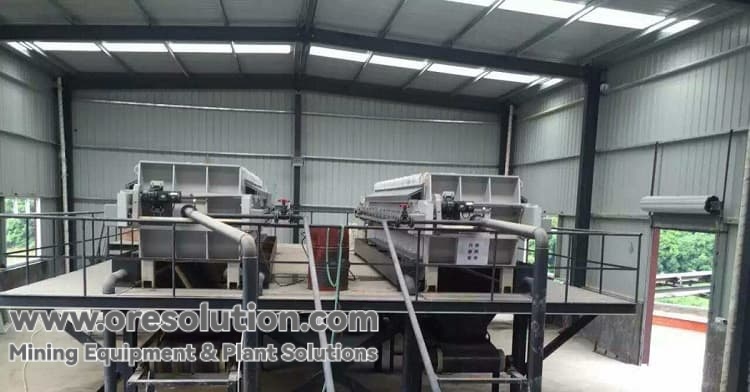
Step 6: Establish an operations and maintenance system. The carbon regeneration cycle, water quality and recirculated water management, cyanide ledgers, and tailings de-cyanidation monitoring form the foundation for long-term, stable operation.The thickening and filter press stages on the equipment side must also be included in routine inspections. When selecting a dewatering system, consider the compatibility between high-efficiency thickeners and the corresponding filter press equipment.
It is difficult to generalize about project timelines and investment costs, as processing capacity, site conditions, and equipment configurations vary greatly; even for the same mineral type, costs between different projects can differ by a factor of several times.
Our Strengths
In the process design for fine-grained disseminated ores such as fine-grained gold, our expertise focuses on three key areas: ore sample testing and process validation, production line layout and equipment configuration design, and support for optimizing performance metrics after production begins.
On the equipment side, we offer complete turnkey solutions—from crushing, grinding, thickening, and leaching/adsorption to desorption, electrolysis, and tailings dewatering—thereby minimizing interface issues between different suppliers. Our manufacturing processes adhere to the ISO 9001 quality management system, and our products are in active operation across multiple mining markets.
It should be noted that we do not apply the same configuration to different mines. When ore properties change, parameters such as tank volume, the number of stages, and carbon density must be adjusted accordingly.
Returning to the question of how to process fine-grained gold.The issues that a CIP processing solution for fine-grained gold can address are clear: the leaching and recovery of fine-grained disseminated gold, the challenge of solid-liquid separation in high-silt-content ores, and the stability of performance indicators under continuous production conditions. The issues it cannot address are equally clear: carbon-bound gold, arsenic-sulfur-encapsulated gold, and an excessively high proportion of coarse-grained gold.
The recommended evaluation sequence is as follows: first, examine the grain size and occurrence of gold; second, assess the clay content and filtration performance; and finally, evaluate the cyanide management conditions.If all three criteria are met, the CIP processing scheme for ultrafine gold is a mature and reliable approach; if one criterion is clearly unsuitable, address that issue first or switch to a combined process.